Let's Build an
Agent Harness
The twenty lines under every agent — and the truck they can drive.
Driving a truck.
Same tool that writes my code — running on a Raspberry Pi, driving a toy Cybertruck. How is a robot the same program as a coding assistant?
Hi, I'm Varun.
The chef is the talent.
The kitchen is the harness.
A kitchen is everything around the cook that turns raw talent into dinner — on time, every night. An agent harness is the same thing around a model: the model can reason, but the harness is what turns reasoning into work you can serve. Swap the chef — the kitchen still ships dinner.
A new resource to manage.
For decades, backend meant three resources — and each earned a management layer. Intelligence is the fourth: metered, it scales and throttles, and it fails in new ways. The harness is how you manage it.
You never manage a resource
by hand.
Each layer allocates the resource, hides its failure modes, and hands you a clean interface. The harness is that layer for intelligence.
The model is the smallest piece of the system — and it keeps shrinking. Everything that makes an agent work is the harness around it. Swap the model, and the same harness holds the output steady.
Build it once.
Reconfigure forever.
Held constant: the loop. The only thing that changes is the configuration — skills, tools, the system prompt. Same engine, different passes.
Every talk today is
a different harness.
- LangGraph — stateful, graph-shaped Dhananjay
- WebMCP + Angular — a harness in the browser Shaikh
- Cost & tokens — the same harness, tuned for the bill Sumit
- Mine — the same loop, driving a truck Varun
Same loop. Different configuration. You'll watch this thesis play out all morning.
Not one loop. A few.
We'll build #1 live. #2 is where guardrails and evals live — a loop wrapped around the loop.
The loop is the engine — about twenty lines. The harness is the car: brakes, mirrors, a fuel gauge, seatbelts. We'll build the whole car.
const tools = {
  read_file: {
    description: "Read a UTF-8 file and return its contents.",
    run: ({ path }) => fs.readFileSync(path, "utf8"),
  },
  write_file: {
    description: "Create or overwrite a UTF-8 file.",
    run: ({ path, content }) => {
      fs.writeFileSync(path, content);
      return `wrote ${content.length} bytes to ${path}`;
    },
  },
};
Two tools. Each is a schema for the model plus a function we run.
async function run(task) {
  const messages = [
    { role: "system", content: SYSTEM },
    { role: "user", content: task },
  ];

  for (let step = 0; step < 10; step++) {
    const { msg } = await callLLM(messages);            //~ think
    if (!msg.tool_calls?.length) return msg.content;    //~ done

    messages.push({ role: "assistant", tool_calls: msg.tool_calls });
    for (const tc of msg.tool_calls) {                  //~ act
      const args = JSON.parse(tc.function.arguments);
      const result = tools[tc.function.name].run(args);
      messages.push({ role: "tool", tool_call_id: tc.id, content: result });
    }
  }
}
Count the lines. ~20. That's loop #1 from two slides ago — the whole agent loop. Everything else is what makes it survivable.
One line each. A whole talk each.
One more tool.
The model didn't change. Its world got bigger. That's the whole game — you upgrade the harness, not the brain.
run_command: {
  description: "Run a shell command.",
  run: ({ command }) =>
    execSync(command).toString(),
},write_file→move()
run_command→drive()
The camera is a tool that returns "wall · 30cm" — MiDaS turns one image into a symbol. Same loop, same twenty lines. It runs Sonnet, not the biggest model: a body needs reflexes more than genius.
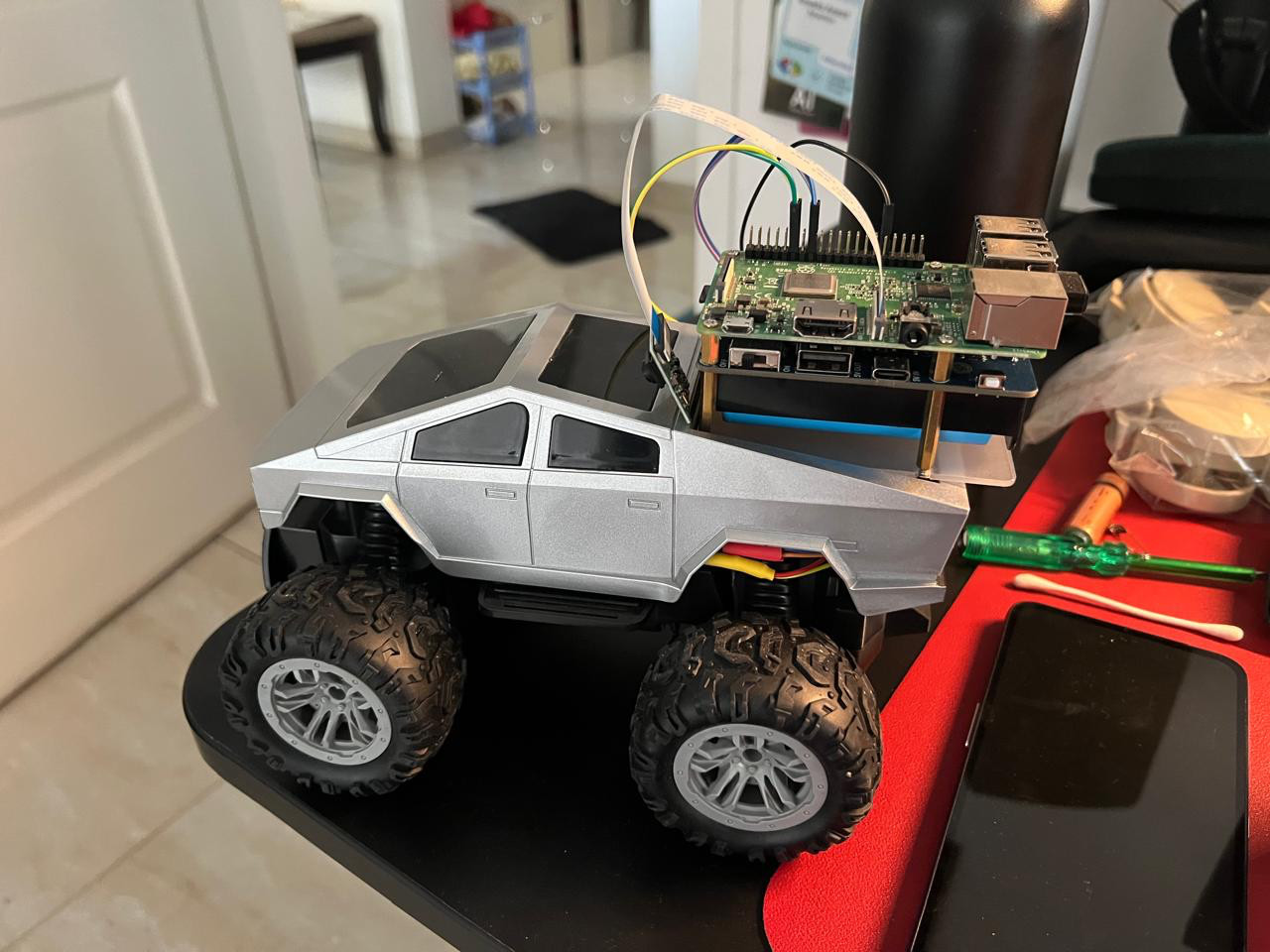
having moved.
A software agent believes it turned left and reasons forward on a fiction. A rover that believes it turned left hits a table leg — in front of all of you. Embodiment gives you the verification loop for free. You just can't turn it off.
Everything a harness manages.
The loop
- agent loop
- stop conditions
- step limits
- sub-agents / delegation
Model
- provider adapter
- structured output
- routing / fallback
- retries & backoff
Tools
- schema validation
- sandboxing
- parallel calls
- MCP
Context & memory
- window management
- compaction / summary
- prompt caching
- long-term memory · RAG
Safety
- permissions / confirm
- budget caps
- guardrails · injection
- rate limits
Quality & ops
- evals / goldens
- tracing
- verification loop
- streaming · checkpoints
● built today, ~130 lines · ○ what production adds — every piece bolts onto the same loop
Thank you.
Own the loop. The model is a commodity.